The Moon and Venus over my house!
Wednesday, December 31, 2008
Tuesday, December 30, 2008
A Thin Crescent Moon
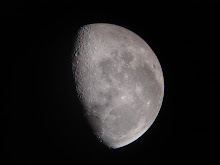
Crescent Moon taken on August 26, 2008
I took advantage of the clear skies and went observing on Monday night. I arrived at LVAAS at sunset and had about half an hour of viewing a thin crescent Moon. It was the thinnest crescent I've viewed through a telescope - thinner than the image above. I managed to identify a small piece of Mare Crisium and a few other craters but it was difficult. I was viewing through some tree branches - so the image was fading in and out - and the view was so limited that I couldn't find the usual landmarks (moonmarks?).
Once I figured out what I was looking at I put away the lunar map and just enjoyed the view until it disappeared.
I then moved on to Venus. It was in a first-quarter phase which I had never seen before. That was cool, too.
I moved around the sky a bit: the Pleiades, Aldeberan, Capella. Then I found M42, the Orion Nebula. This was my first time viewing this great sight. While it didn't look like the Hubble images (which are in color), it was still impressive. It took up the whole field-of-view in the eyepiece and I could easily recognize the shape. It is so hard to imagine just how big this thing is!
So I had another great time looking at the night sky. Let me know if you'd like to join me sometime.
Thursday, December 25, 2008
Moon Course
Image: Mark Tillotson
Instructor: Mark Tillotson
12 weeks, Wednesday nights at 7 - 8 pm, Emmaus High School
Begins on February 4, 2009
NASA is currently planning a return to the Moon and many of it's scientists, engineers and contractors need to learn about the Moon. The Johnson Space Center sponsored Moon 101 - A Course in Lunar Science for Non-Specialists.
Using the information from Moon 101, this course will present the basics of Lunar science that NASA is using to plan future missions to the Moon to set up a permanent base. The course will cover topics such as geology and the physical characteristics of the soil and surface material that will effect living and working there, the crust and interior, environment, poles, and the lessons learned from Apollo. We will also learn about viewing Lunar features from Earth, meteorites, mapping and the search for water.
This course is designed for anyone with an interest in the Moon and astronomy. It will focus on the overview of Lunar science and will not require any special math skills.
The registration form is here. I hope you will join me on this exploration of the Moon.
Monday, December 22, 2008
Monday, December 8, 2008
The Moon and a Crow

I've been wanting this Moon poster for a long time and I finally have it! It's one of those 'early Christmas presents' that are the perfect excuse for spending money on yourself. It was created by my new friend, John Moore, from Ireland.
John Moore currently works as a freelance science and astronomy writer. He maintains a website about the Moon – unpaid and all done on a shoestring.
I see that you're into nature as well as being a lunartic like myself. I'm in the middle of nowhere over here and have loads of pics on nature -- from fungi, to trees, to animals, to birds..etc. Have included a small pic of a common crow I took the other day through my window as he posed for me -- I call it "Woaaaa dude, where's my bread?" :-)))
It's a great picture of an agitated crow! I think I've seen the same bird in my yard looking for sunflower seed...
Tuesday, November 11, 2008
Moon 101
This is from the 11/11/2008 LPOD by Chuck Wood:
I'm downloading the files now. I've looked at some of the pages and they are great - if you're a lunatic like me!
A few years ago I taught online courses about lunar geology. Now NASA is actively working to return to the Moon and finds that many of its engineers and others need to learn about the Moon. Not just geology, but especially information about the physical characteristics of the soil and near surface material that will effect living and working there. So this year Johnson Space Center sponsored Moon 101 - A Course in Lunar Science for Non-Specialists, ten lectures apparently organized by Paul Spudis. The wonderful thing is that the Powerpoints - all 80 MB of them - are online for download and study by anyone interested. I printed them all out and spiral bound them, adding another significant reference to my lunar library collection. The presentations include basic geologic topics such as the surface, crust, and interior, and also more practical matters such as the environment, poles and lessons learned from the Apollo missions and where future bases should be sited. The last talk is on lunar meteorites, a wonderful source of free samples of the Moon (although you have to pay to go to Antarctica, the Sahara or Australia to find many), but their origin locations are unknown. Many LPOD readers will find some of this material familiar, but other parts, especially the geochemistry and petrology of lunar samples, will be new and somewhat complex. But download it, and as you read through remember that you are getting the same information as the NASA scientists and engineers who will take us back to the Moon. Thanks, Paul, for sharing these Powerpoints!
I'm downloading the files now. I've looked at some of the pages and they are great - if you're a lunatic like me!
Monday, November 10, 2008
Today in Astronomy: Vesto Slipher

Vesto Melvin Slipher, born on November 11, 1875 (d. November 8, 1969), was an American astronomer. He spent his entire career at Lowell Observatory in Flagstaff, Arizona, where he was director from 1916 to 1952. He used spectroscopy to investigate the rotation periods of planets and the composition of planetary atmospheres. In 1912, he was the first to observe the shift of spectral lines of galaxies, so he was the discoverer of galactic redshifts.
John Peacock, head of the Institute for Astronomy at the University of Edinburgh, states:
a very large share of the credit for the discovery of the expanding universe is due to Slipher, and yet he tends to take very much second place to Hubble in most accounts.
While it was Edwin Hubble who received all the publicity, Vesto Slipher actually made the discovery that galaxies are moving away from us. He also determined that the Andromeda Galaxy is moving towards the Milky Way!
Slipher was also responsible for hiring Clyde Tombaugh and supervised the work that led to the discovery of Pluto. His brother Earl C. Slipher was also an astronomer. The Moon crater Slipher and a crater on Mars are named in his honor.
Vesto Slipher died in Flagstaff, AZ on November 8, 1969 at the age of 93. He was one of the giants of astronomy and deserves greater recognition.
Sources:
http://www.roe.ac.uk/~jap/slipher/
http://www.lowell.edu/Research/library/paper/vm_slipher.html
http://en.wikipedia.org/wiki/Vesto_Melvin_Slipher
Subscribe to:
Posts (Atom)
